 Foshan Xinliheng Stainless Steel Co., Ltd.(佛山市鑫利恒不锈钢有限公司)

Three years ago, I thought shopping mall interiors were all about marble, glass, and giant LED screens—the shinier, the better.
Then I walked into a high-end mall in Shenzhen with a client. He pointed at the elevator doors, the info desk, even the trash bin surrounds, and said:
“All of this? Just 0.8mm stainless steel sheet.”
I blinked. “That thin? Won’t it dent?”
He laughed. “Kid, in commercial spaces, it’s not about thickness—it’s about precision.”
That one sentence changed how I sell forever.
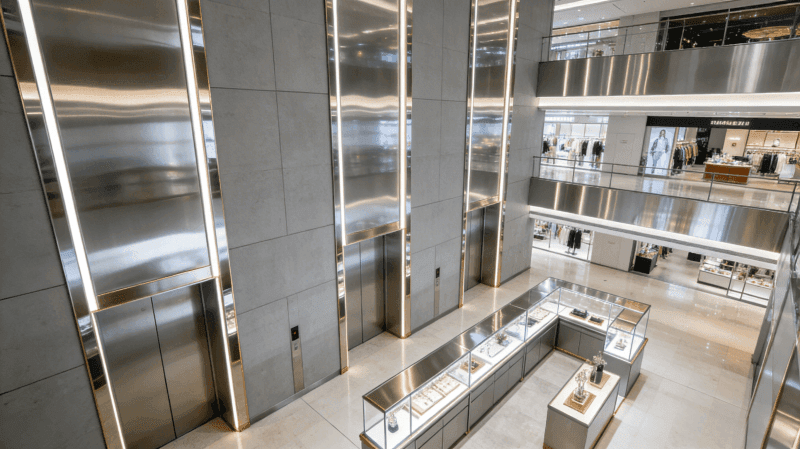
Why Do Malls Love Thin Stainless Steel?
Most people hear “thin stainless” and worry: Is it strong enough? Will it warp?
But in shopping malls—where design, speed, and maintenance matter more than brute strength—0.6mm to 1.5mm stainless sheets are actually the sweet spot.
But in shopping malls—where design, speed, and maintenance matter more than brute strength—0.6mm to 1.5mm stainless sheets are actually the sweet spot.
First, they’re lightweight.
Mall cladding is rarely structural. It’s usually wrapped over drywall, wood frames, or aluminum substrates. Heavy plates mean more labor, more support, longer install times. With 1.0mm sheets? Two guys can panel an entire column in an hour.
Mall cladding is rarely structural. It’s usually wrapped over drywall, wood frames, or aluminum substrates. Heavy plates mean more labor, more support, longer install times. With 1.0mm sheets? Two guys can panel an entire column in an hour.
Second, they’re cost-efficient—without looking cheap.
Less material = lower cost per sqm. Lighter weight = cheaper shipping. Faster installation = lower labor bills. For projects covering thousands of square meters, those savings add up fast.
Less material = lower cost per sqm. Lighter weight = cheaper shipping. Faster installation = lower labor bills. For projects covering thousands of square meters, those savings add up fast.
And most importantly: they look just as premium as thick plates—sometimes even better.
Modern surface finishes like brushed, mirror, PVD color (rose gold, antique copper, matte black), or etched patterns give thin sheets serious visual impact. Plus, their flexibility makes them perfect for curves, corners, and custom shapes—something rigid thick plates struggle with.
Modern surface finishes like brushed, mirror, PVD color (rose gold, antique copper, matte black), or etched patterns give thin sheets serious visual impact. Plus, their flexibility makes them perfect for curves, corners, and custom shapes—something rigid thick plates struggle with.
Where You’ll Find Thin Stainless in Malls (Spoiler: Everywhere)
It’s not just elevator doors anymore. After visiting dozens of malls across Asia, the Middle East, and Europe, I’ve seen thin stainless used in ways I never imagined:
- Service desks & concierge counters: Brushed champagne gold or satin gray—durable, fingerprint-resistant, and instantly upscale.
- Escalator & elevator trims: 316-grade with anti-fingerprint coating, surviving thousands of daily touches without looking worn.
- Storefront frames & signage: Narrow rose gold borders around brand logos make tenants look luxury—even if they’re not.
- Restroom partitions & mirror frames: Matte finishes reduce glare; antimicrobial options keep things hygienic.
- Ceiling reveals & light coves: 0.6mm mirror sheets reflect ambient lighting, making atriums feel larger and brighter.
- Even trash enclosures: Wrapped in matching brushed stainless so they disappear into the design—not an eyesore.
One mall in Dubai used 0.8mm antique bronze sheets to wrap every column in the food court. During golden hour, the whole space glowed like an old bazaar. No paint. No film. Just smart material choice.
My Rookie Mistake (And What I Learned)
Early on, a client in Saudi Arabia asked:
“Can you supply 1.2mm brushed stainless for a new mall in Jeddah?”
I replied instantly: “Yes! Great quality, very strong!”
Then came the follow-up:
“Is it 316 for coastal humidity? Does it have anti-fingerprint treatment? Can you guarantee color consistency across 1,800 sqm?”
I froze.
Turns out, mall projects live or die by the details.
Turns out, mall projects live or die by the details.
- Coastal cities? Must be 316—304 will show rust spots within a year.
- High-touch areas? Anti-fingerprint coating isn’t optional—it’s a sanity-saver for cleaning crews.
- Large installations? Batch-to-batch color variation can ruin the whole look. You need tight process control.
Now, I start every conversation with questions:
“Where’s the project? Indoor or semi-outdoor? Expected foot traffic? Any reference images?”
“Where’s the project? Indoor or semi-outdoor? Expected foot traffic? Any reference images?”
Not to sound smart—but because I’ve seen what happens when you guess wrong. And no one wants to replace 500 sqm of discolored panels after handover.
Final Thought: Thin ≠ Weak
People assume “thin” means “cheap.”
But in commercial architecture, using the right thickness is a sign of expertise—not compromise.
But in commercial architecture, using the right thickness is a sign of expertise—not compromise.
Thin stainless doesn’t shout. It doesn’t dominate.
But it holds the whole space together—quietly, reliably, beautifully.
But it holds the whole space together—quietly, reliably, beautifully.
As an export salesperson, I’ve stopped pushing “thicker = better.”
Instead, I ask: What problem are you solving?
Because often, the answer isn’t a heavy plate—it’s a smart, lightweight, well-finished stainless sheet that saves time, money, and headaches.
Instead, I ask: What problem are you solving?
Because often, the answer isn’t a heavy plate—it’s a smart, lightweight, well-finished stainless sheet that saves time, money, and headaches.
Last week, that Jeddah mall project finally confirmed.
1.0mm, 316 base, brushed antique copper, anti-fingerprint, full batch traceability.
The client’s last message?
1.0mm, 316 base, brushed antique copper, anti-fingerprint, full batch traceability.
The client’s last message?
“You understood our real needs.”
That’s the win I didn’t know I was chasing three years ago.
