 Foshan Xinliheng Inoxydnus Steel Co., Ltd. (佛山市鑫利恒不锈钢有限公司)

Avez-vous déjà eu ce moment? Au moment où vous poussez la porte, votre souffle se bloque, vos pas ralentissent instinctivement, et vous hésitez même à sortir votre téléphone, de peur de rompre le sort. La semaine dernière, Je suis tombé sur un nouveau concept store de beauté près du temple Jing’an à Shanghai, et cela m'a donné exactement ce sentiment. It wasn’t about plastering logos everywhere or bombarding customers with celebrity endorsements. Instead, it used an almost obsessive design language—champagne gold curved display units, flowing light strips, and a dialogue between mirrors and metal—to transform a retail space into an immersive aesthetic theater.
Let’s start with the “star of the show” that kept me standing still for ten minutes: the champagne gold curved display cabinets.
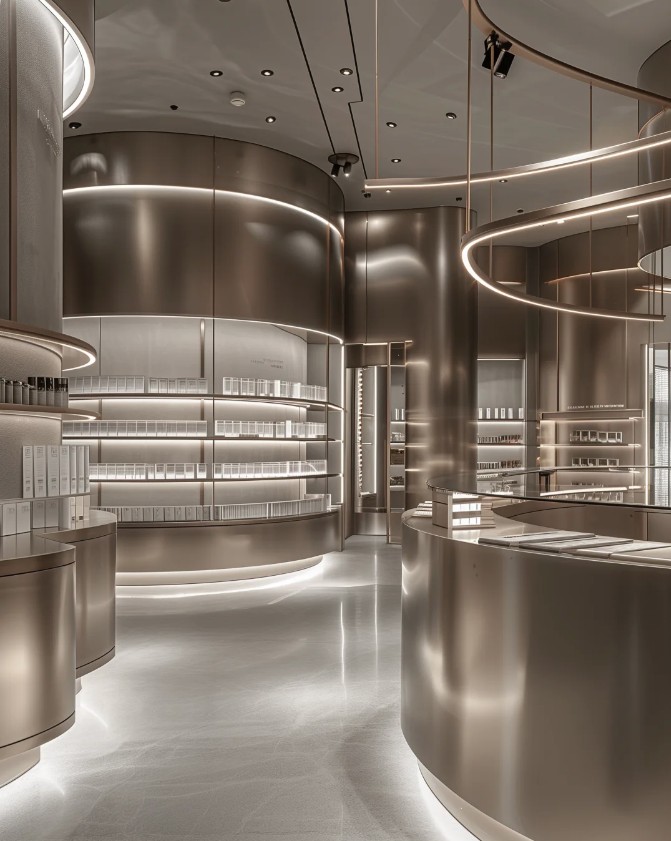
These aren’t your traditional shelves; they look more like sculptures suspended in mid-air. Every unit features smooth, fluid curves—no sharp corners, no abrupt turns. They resemble metallic waves gently smoothed by a soft hand. The surface has a matte champagne gold finish—not flashy, but inherently noble. Light subtly seeps in from the top and bottom, outlining their contours and making the products appear as if they’re floating in a halo of glow. When you approach, you don’t feel like you’re “picking out products”; you feel like you’re admiring a carefully choreographed visual performance.
The layout is brilliant. There are no straight aisles in the entire store. All movement paths are guided by these curved displays, leading you on a winding journey. Before you know it, you’ve looped back to where you started, but your perspective has completely shifted. Products you missed earlier are now staring right at you, glowing softly. Psychologically, this is called “unconscious exploration.” In plain English: it makes browsing so comfortable that you just want to do another lap.
Then there are the materials. Beyond the champagne gold, the store heavily utilizes brushed stainless steel, frosted glass, and micro-cement flooring. None of these materials are exorbitantly expensive on their own, but combined, they create an atmosphere of “understated luxury.” The flooring, en particulier, has just the right amount of reflectivity—it mirrors the displays beautifully without making you feel dizzy or worried about slipping. The circular light strips hanging from the ceiling look like modern art installations. They aren’t just for illumination; they act as the rhythm keepers of the space. As you move, the light and shadow shift slowly, as if dancing along with you.
Of course, what truly won me over was the attention to detail.
Take the checkout counter, for instance. It follows the same curved design, with LED strips embedded into the countertop. When the staff hands you your purchase, the action feels like a ritualistic delivery. The makeup testing area is tucked behind semi-transparent screens—private yet not closed off. The mirrors are framed with a ring of warm white light that makes skin look translucent and radiant, making even foundation look more seamless. Even the restroom corner didn’t get overlooked: the faucets are hidden sensor models, a small bottle of scented hand cream sits by the sink with elegant, slender typography on the label, and even the tissue box is a custom brass color.
You might ask, “With all this focus on design, are the prices sky-high?” Actually, no. The store focuses on a mix of “niche boutique brands and international giants.” You’ll find luxury serums costing over a thousand yuan right next to affordable gems under a hundred. The key is that every product, regardless of price point, is treated equally—placed in the same displays, bathed in the same lighting. This is a clever psychological hint: here, there are no “cheap items,” only “beauty worth owning.”
I also took the time to observe customer behavior. Most people don’t rush straight to their target product upon entering. Instead, they stroll slowly along the curved displays, occasionally stopping to take photos or running a hand along the edge of a counter to feel the texture. I even saw a girl crouch down just to inspect the packaging details of a lipstick on the bottom shelf. What does this tell us? It means the space successfully triggered people’s “desire to possess” and “urge to share.” You want to own it, and you want to tell others you’ve found a treasure.
Speaking of which, I have to mention the design philosophy behind it. According to the store manager, they hired a team that previously worked on high-end department stores in Ginza, Tokyo. Their core concept was “de-commercialization.” What does that mean? It means ensuring customers don’t feel “sold to.” Instead, they are immersed in a beautiful environment where the desire to buy arises naturally. So, you won’t see promotional posters, hear broadcast announcements, or encounter pushy salespeople. Even the staff wear minimalist uniforms and speak in soft tones, acting more like personal styling consultants than cashiers.
This “anti-marketing” strategy is surprisingly effective in today’s information-overloaded era. People are tired of endless ads and forced recommendations; they are more willing to pay for “experiences.” And this store delivers exactly that scarce emotional value. Shopping here isn’t about completing a task; it’s a ritual of self-reward.
Enfin, I want to say that true “high-end vibes” never come from just throwing money at a problem. It can be a beam of perfectly placed light, a resilient curve, or a restrained shade of color. Just like the champagne gold displays in this store: they don’t speak, yet their form tells a story of taste; they aren’t loud, yet their details conquer the heart.
If you’re someone with an obsession for beauty, try spending an afternoon in a space like this. Don’t rush to buy anything. Just watch how the light flows, feel the temperature of the metal, and listen to see if your heartbeat slows down and becomes steady. You might discover that the texture of life often hides in these seemingly useless but truly healing details.
After all, isn’t the reason we work hard to earn money so we can live more like works of art ourselves?
—
[Bonus Easter Egg]
Here’s a little secret: this store doesn’t have an online shop yet, nor does it offer delivery. Want to get your hands on a favorite item? You have to go in person, pick it up, confirm it with your own eyes, and listen to the staff explain the ingredient story. This “uncopyable” experience might just be its biggest selling point.
Here’s a little secret: this store doesn’t have an online shop yet, nor does it offer delivery. Want to get your hands on a favorite item? You have to go in person, pick it up, confirm it with your own eyes, and listen to the staff explain the ingredient story. This “uncopyable” experience might just be its biggest selling point.
(I won’t drop the address here; I’ll leave it for the destined ones to discover on their own~)

It’s a pity you don’t have a donate button! I’d without a doubt
donate to this fantastic blog! I suppose for now i’ll settle for book-marking and adding your
RSS feed to my Google account. I look forward to
brand new updates and will talk about this website
with my Facebook group. Talk soon!
Hi there, just wanted to tell you, I enjoyed this post.
It was practical. Keep on posting!
What’s up, for all time i used to check webpage posts here early in the daylight, as
i like to find out more and more.