 Foshan Xinliheng Inoxydnus Steel Co., Ltd. (佛山市鑫利恒不锈钢有限公司)

An automobile’s exhaust system primarily consists of the exhaust manifold, front pipe, flexible pipe, catalytic converter, center pipe, main muffler, and tailpipe. Each component operates in different temperatures and environments, necessitating the use of different stainless steel and other materials.
Stainless Steel Pipes for Automobile Exhaust Systems
Stainless Steel Pipes for Automobile Exhaust Systems
Par exemple, in high-temperature areas near the engine, exhaust component materials require excellent high-temperature strength, thermal fatigue resistance, high-temperature oxidation resistance, et résistance à la corrosion. Areas farther from the engine require resistance to exhaust gas condensation corrosion. De plus, stainless steel tailpipes exposed at the rear of the vehicle require not only corrosion resistance but also an aesthetically pleasing surface.
La fonction du collecteur d'échappement est de diriger les gaz d'échappement des cylindres du moteur vers le tuyau d'échappement. Parce que le collecteur d'échappement est directement monté sur le moteur et que les températures des gaz d'échappement peuvent atteindre environ 900°C, le matériau utilisé doit posséder une excellente résistance à l'oxydation, une résistance élevée à la température, et une résistance à la fatigue thermique. De plus, en raison de la forme complexe du collecteur d'échappement, le matériau doit également présenter une bonne formabilité.
Les collecteurs d'échappement en acier inoxydable peuvent être classés en deux types en fonction de leurs méthodes de production: l'un est fabriqué par emboutissage de tôles d'acier inoxydable puis soudage, et l'autre est fabriqué par pliage et soudage de tubes en acier inoxydable. Ce dernier comprend également la fabrication basée sur des manchons.
Stainless steels used in exhaust manifolds include austenitic and ferritic stainless steels. Austenitic stainless steels offer excellent high-temperature strength, but their oxidation resistance is inferior to that of ferritic stainless steels due to their easy flaking of oxide scale. Austenitic stainless steels used in exhaust manifolds include 304 and XM15J1. While ferritic stainless steels offer better oxidation resistance, their high-temperature strength is weaker than austenitic stainless steels. Cependant, due to their lower thermal contraction coefficient, ferritic stainless steels exhibit better thermal fatigue properties than austenitic stainless steels. Ferritic stainless steels used in exhaust manifolds include 409L and 430J1L.
The front pipe is located between the exhaust manifold and the flexible pipe. To ensure catalytic activity in the downstream catalytic converter, heat radiation from the front pipe must be minimized to prevent a drop in exhaust gas temperature. De plus, the front pipe must also provide noise reduction. Donc, front pipes are shifting from traditional single-layer tube structures to thin-walled sleeve structures. Materials used for front pipes include ferritic stainless steels such as 409L, 436L, and 430J1L. When using a sleeve structure, the inner tube is also made of austenitic stainless steel. Ferritic stainless steel, due to its low cost and excellent oxidation resistance and thermal fatigue properties, will be widely used as the primary material for front pipes. De plus, to address the trend of rising exhaust temperatures and thinning pipe walls, steel grades with better high-temperature performance, such as 429 acier inoxydable, are also being used.
Flexible pipes are located between the exhaust manifold and the catalytic converter, primarily to prevent engine vibration from being transmitted to other components of the exhaust system. Flexible pipes are constructed of a corrugated sleeve wrapped in a stainless steel wire mesh braid. The material used for flexible pipes must exhibit excellent high-temperature fatigue resistance, and because of the corrugated shape, the material must also possess excellent processability. De plus, in cold regions, deicing salt is used to prevent road icing, so the outer surface of the flexible pipe must also be resistant to high-temperature salt corrosion. Actuellement, the primary material used for flexible tubing is 304. Cependant, considering the need for high-temperature salt corrosion resistance on the outside of the tubing in cold regions, the higher-performance XM15J1 steel grade, which incorporates silicon and has a higher nickel content, can be used.
To reduce air pollution from automobile exhaust, an exhaust purification system called a catalytic converter is also required. It converts carbon monoxide and hydrocarbon pollutants in exhaust gas into carbon dioxide and water, and nitrogen oxides into nitrogen and oxygen. The converter consists of a catalyst, a co-catalyst, a sealing coating, and a catalyst carrier.
Because the catalytic converter is located close to the exhaust manifold and under the chassis, it must be able to withstand harsh corrosion environments such as high temperatures and vibration. In addition to ceramic carriers, metal carriers made of ferritic stainless steel foil are also used. Ferritic stainless steel foil is used because of its excellent thermal shock resistance and low heat capacity. The metal catalyst carrier consists of a honeycomb core made of stainless steel foil and a shell made of stainless steel plate. The honeycomb core is made by winding flat and corrugated foil and joining them together using methods such as brazing or welding. The outer shell must possess excellent high-temperature strength, high-temperature salt corrosion resistance, and processability.
The catalytic converter shell is primarily made of 430 acier inoxydable, but to cope with rising exhaust gas temperatures, ferritic stainless steels with better high-temperature performance, such as 430J1L and 429 series, are now being used.
Le tuyau central relie le convertisseur catalytique au silencieux principal. Certains modèles installent également un silencieux secondaire dans le tuyau central. Les températures des gaz d'échappement sont relativement basses dans cette zone, donc les exigences de performance à haute température sont moins strictes, mais la résistance à la corrosion est très exigeante. La résistance à la corrosion interne et externe cible principalement la corrosion causée par l'eau condensée dans les gaz d'échappement, alors que la surface doit résister à la corrosion due au sel de déneigement. Traditionnellement, le tuyau central était fabriqué en acier au carbone galvanisé, mais l'utilisation de l'acier inoxydable pour lutter contre la corrosion de la surface interne augmente rapidement. Les aciers inoxydables utilisés pour les tuyaux centraux comprennent 410, 409L, et 430.
Le silencieux principal absorbe et réduit le bruit des gaz d'échappement. Il se compose d'une coque extérieure, de panneaux internes, d'un tube interne, et de panneaux d'extrémité. During extended driving, the exhaust heats the main muffler, reaching temperatures of around 400°C. During this period, moisture does not condense. Cependant, during shorter driving periods, the main muffler’s temperature remains constant, allowing moisture to condense. Condensed water contains substances such as NH₄⁺, CO₂⁻, SO₂⁻, Cl⁻, and organic acids. These substances gradually concentrate during repeated engine starts and stops. The presence of condensate creates a highly corrosive, wet environment inside the muffler. De plus, the muffler surface is exposed to the corrosive environment of deicing salt.
Actuellement, the main muffler is primarily made of 436L, but the use of 436J1L is increasing because this stainless steel grade requires less molybdenum, thus reducing costs.
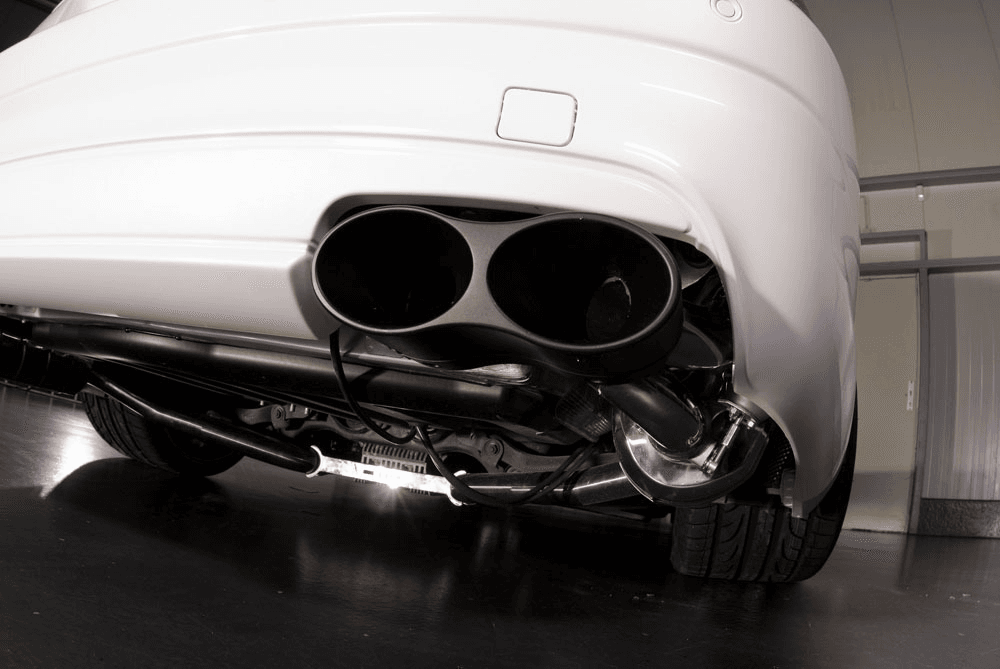
The tailpipe, located behind the main muffler, is the final exhaust outlet and a visible component. Donc, it must be both corrosion-resistant and aesthetically pleasing. Because exhaust gas temperatures in the tailpipe area are historically low, aluminum-plated steel is sufficient. Cependant, for aesthetic reasons, high-purity ferritic stainless steels such as 409L, 430, et 436, as well as austenitic 304 acier inoxydable, are sometimes used. When aesthetics are particularly demanding, chrome-plated or hot-dip aluminum-plated steel grades are also used, while YUS731 is resistant to high-temperature salt corrosion.
The automotive industry is a major user of stainless steel, primarily in exhaust systems and decorative components. 400 series stainless steels are primarily used, with representative grades including 409L, 436L, et 430.