 Foshan Xinliheng Edelstahl Co., Ltd.(佛山市鑫利恒不锈钢有限公司)

For years, I thought stainless steel kitchens belonged in restaurants or labs—not homes.
Cold. Clinical. Clangy.
Cold. Clinical. Clangy.
Then last month, at a design fair in Milan, I walked into a kitchen that stopped me mid-step.
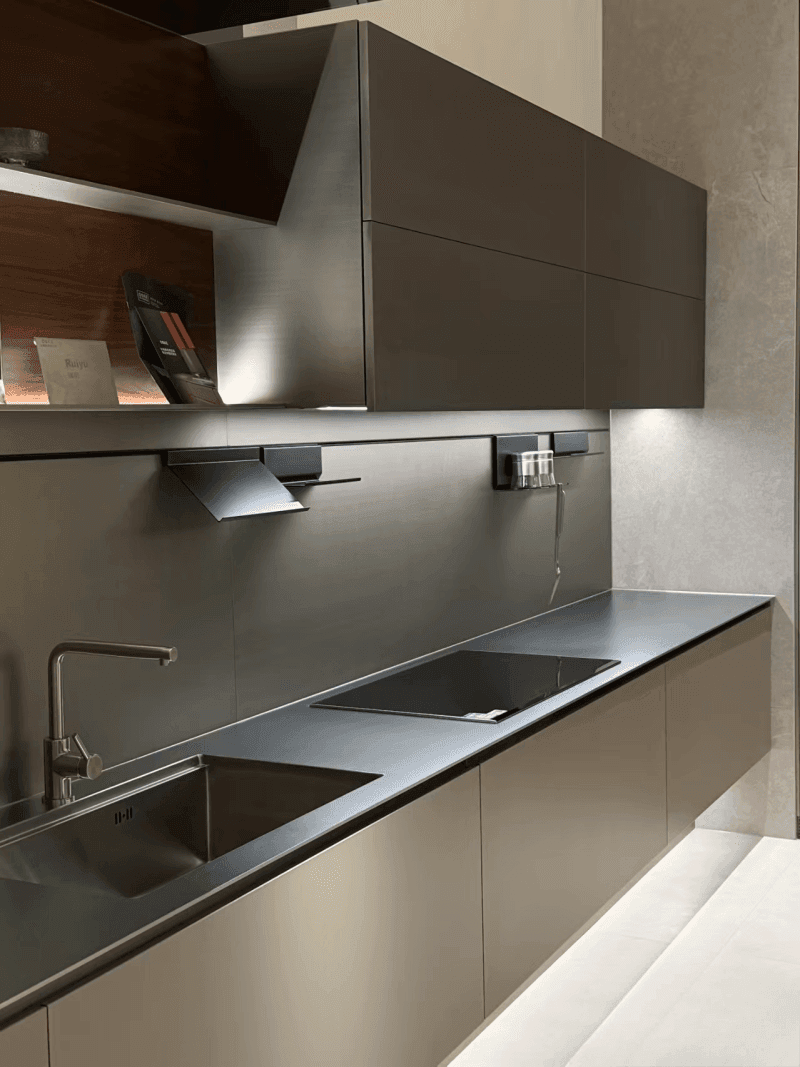
Floor-to-ceiling cabinets. Seamless countertops. Backsplashes that flowed right into the walls. All in soft gray stainless steel—with zero handles, hidden lighting, and not a single fingerprint in sight.
It didn’t feel like a kitchen. It felt like the cockpit of a luxury spaceship.
And the craziest part? It looked warmes.
That’s when I realized: stainless steel isn’t cold anymore—it’s quietly becoming the smartest choice for modern homes.
Why Are Designers Suddenly Obsessed With It?
Let’s be real—most people still picture hospital hallways or industrial sinks when they hear “stainless steel.”
But today’s residential-grade stainless cabinets are nothing like that.
But today’s residential-grade stainless cabinets are nothing like that.
We’re talking 304 oder 316 stainless, finished in brushed satin oder micro-matte texture—so soft to the touch it feels more like fine fabric than metal. No harsh reflections. No glare. Just calm, clean lines.
And beyond looks, it’s brutally practical:
- Wipe oil splatter with a damp cloth—gone.
- Humid bathroom? Coastal air? No warping, no mold.
- Spilled boiling water? Doesn’t care.
- Forget termites, swelling, or peeling laminate.
For clients in places like Singapore, Miami, or Dubai—where humidity eats wood alive—stainless isn’t just stylish. It’s survival.
Real Homes, Real Uses (Not Just Showrooms)
I used to think this was only for “ultra-minimalist” tech bros. But then I saw how real people use it:
- A luxury apartment in Shanghai: Full stainless kitchen in warm gray, paired with light oak floors. Feels serene, not sterile.
- A boutique hotel suite in Dubai: Küche + bathroom fully clad in seamless stainless—housekeeping loves it; guests think it’s “next-level.”
- A food blogger’s home in Singapore: She films cooking videos daily. Her stainless kitchen stays camera-ready 24/7. “I don’t stress about mess anymore,” she told me. “Just wipe—and it’s perfect.”
One project blew my mind: a modern tea house in Beijing. They used deep charcoal brushed stainless for the counter backdrop—paired with raw wood tables and stone teapots. The contrast was stunning: ancient ritual meets future material.
And Yes—Stainless Steel in Bathrooms Too!
This surprised me most. But think about it: bathrooms are wet, steamy, and full of germs. Wood swells. Paint peels. Grout molds.
Stainless? Thrives.
Here’s how it’s being used:
- Shower enclosures: Framed in 2mm brushed stainless—no rust, no white corrosion like aluminum.
- Vanity tops: Seamless, non-porous surfaces where bacteria can’t hide.
- Wall accents: Mirror frames, towel bars, even toilet tank covers—in matching finishes for a unified look.
One client in Thailand runs a high-end boutique resort. He lined an entire bathroom in black brushed stainless. With warm LED strips behind the mirror, it glows like a scene from Blade Runner—but cozy.
Guests say: “It feels futuristic… but weirdly relaxing.”
Guests say: “It feels futuristic… but weirdly relaxing.”
My Rookie Mistake (And What I Learned)
Early on, I’d pitch it like this: “We make stainless kitchen panels—cheap and strong!”
Sounded confident. Was actually clueless.
Sounded confident. Was actually clueless.
Then a German interior designer asked:
“Can you do seamless radius corners? Is there an antimicrobial coating option? What’s your tolerance on flatness for large panels?”
I froze.
Turns out, selling stainless for homes isn’t about material—it’s about experience.
Key things I now check:
- Thickness matters: Countertops need ≥1.5mm to avoid flexing; wall panels can be 0.8–1.2mm.
- Finish consistency: Brushed grain must run uniformly across all panels—no patchy spots.
- Edge detailing: Rounded, polished edges feel premium; sharp ones feel cheap (and dangerous).
Now I start with: ‚Wo ist das Projekt‘? Humid climate? Will it be photographed often? Any hygiene requirements?”
Because getting it wrong means a beautiful kitchen that feels off.
Because getting it wrong means a beautiful kitchen that feels off.
Abschließender Gedanke: Stainless Can Feel Like Home
I used to believe “home” meant wood, fabric, Wärme.
Now I know: true comfort is peace of mind.
Now I know: true comfort is peace of mind.
A stainless kitchen doesn’t yellow. Doesn’t warp. Doesn’t need resealing every year.
It just… works. Quietly. Reliably. Beautifully.
It just… works. Quietly. Reliably. Beautifully.
As an export rep, I’ve stopped selling “metal sheets.”
I’m selling a life with less worry—fewer cleaning battles, fewer replacements, fewer regrets.
I’m selling a life with less worry—fewer cleaning battles, fewer replacements, fewer regrets.
Last week, that Singapore food blogger ordered a full bathroom system to match her kitchen.
Her note said: “You didn’t sell me steel. You sold me freedom.”
Her note said: “You didn’t sell me steel. You sold me freedom.”
Honestly? That’s the best compliment I’ve ever gotten.
— A once-skeptical export guy who now sees stainless steel not as metal—but as a promise of calm.
Naturally included SEO keywords: stainless steel kitchen cabinets, seamless stainless countertops, residential stainless steel interiors, 304 stainless bathroom cladding, brushed satin stainless panels, antimicrobial stainless surfaces, modern kitchen design, luxury bathroom metal finishes, coastal-resistant cabinetry, integrated stainless vanity
